
Young vs Mature Areca Fruit: Why Harvest Stage Matters
Understand harvest maturity as a processing decision and learn why young fruit, mature kernels and dried export grades should not be treated as equivalents.
Young areca fruit, mature fruit and dried kernels describe different stages or conditions. They should not be treated as equivalent products merely because each comes from the same palm.
Harvest maturity is therefore both an agricultural observation and a processing decision. The intended output determines which questions matter, while the actual condition of the material must still be checked.
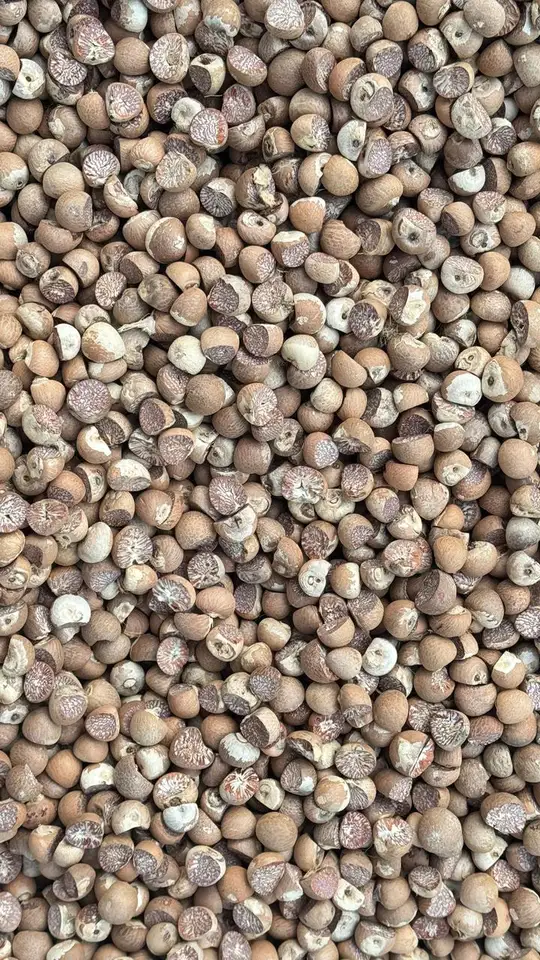
Maturity and dryness answer different questions
Maturity concerns the development of fruit at harvest. Dryness concerns its water condition after a drying process or period. A dried appearance does not, by itself, explain the original harvest stage.
This distinction becomes important when comparing descriptions. Young fruit intended for one process cannot automatically be substituted for mature material intended for another. A product sheet should state the relevant harvest condition and the preparation that follows.
Use indicators within their proper context
Indonesian areca cultivation guidance describes maturity indicators when discussing fruit selected for seed. That is a specific agricultural purpose; it should not be turned into a universal visual acceptance rule for every commercial product.
For an actual operation, agree with the technical adviser on the indicators appropriate to the intended use. Record the observations rather than relying only on an informal expression such as ready fruit, whose meaning may vary between people.
Reference: Ministry of Agriculture: areca cultivation and seed selection guidance
Evaluate the resulting material, not just the starting label
When comparing material harvested at different stages, keep the preparation and evaluation method explicit. Measure the outcomes relevant to the intended process rather than assuming one stage is always more valuable.
Include the amount received, useful output, rejects and handling observations. If the process itself changes between trials, record that too. Otherwise a result attributed to maturity may actually reflect a different preparation method.
Avoid claims that maturity establishes safety or superiority
A young or mature label is not a health claim and does not remove the known risks of chewing areca nut. Nor does it establish a universal price advantage, shelf life or processing yield.
The useful conclusion is narrower: define the intended material, document its condition and assess it against the requirements of the actual application. That turns harvest maturity into an informative part of the product story rather than a vague quality slogan.