
Betel Nut Menir: Fragments, Specifications and Uses
Understand Indonesian betel nut menir, how to describe fragments and screenings, and why a low-priced by-product still needs clear acceptance criteria.
Menir is a term buyers may encounter when discussing small broken material or screenings rather than selected whole nuts or regular split cuts. In an areca nut offer, the word needs a physical explanation: the size distribution, condition and origin of the fragments matter more than the label.
Treat this article as a way to understand a secondary material stream, not an announcement of Betel.trade inventory. Availability, suitability and any lawful end use would have to be established for a particular lot.
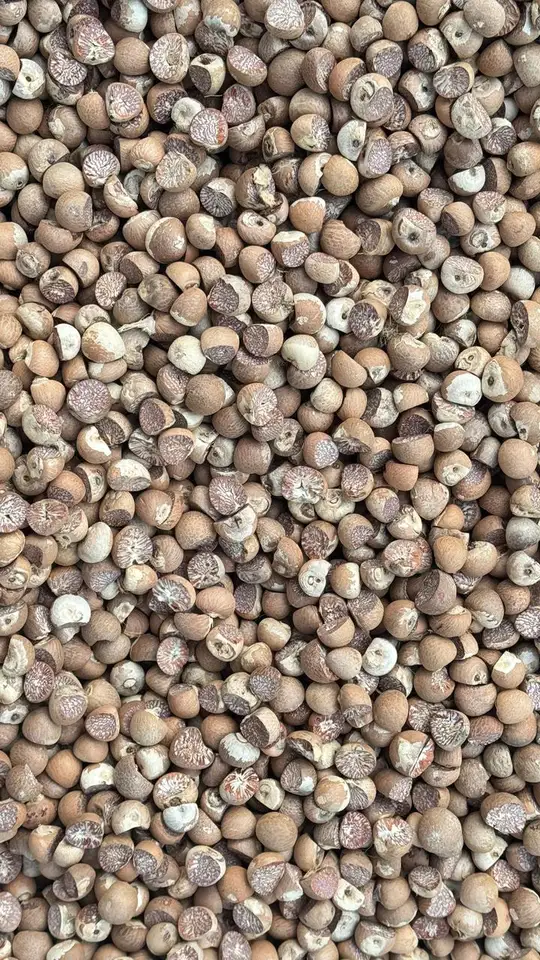
Describe what is actually in the sack
A useful description identifies whether the material is kernel fragments, fine screenings or a mixture, and whether husk or other foreign matter is present. Pieces generated during cutting may differ from material rejected after storage. Calling both waste does not explain their condition.
Photographs can show the general form, but a representative sample is needed to discuss how much material falls into each size category. Agree on the measurement basis before using a percentage in an offer.
A by-product still needs acceptance criteria
A low price does not remove the need to check identity, moisture, contamination and suitability for the intended process. Visible deterioration or unknown treatment history should not be hidden behind a waste-grade description.
The appropriate tests depend on the intended application and destination requirements. Do not assume that material unsuitable for one market can simply be redirected to food, feed, cosmetics or extraction. Those applications have their own technical and regulatory questions.
Evaluate use through a controlled trial
For an eligible material-development project, start with the downstream specification and work backward. Does the process require a particular particle range, composition or consistency? Can it tolerate the variation found in the proposed supply? A trial should answer those questions explicitly.
Record preparation time, accepted input and rejected output alongside any useful result. That reveals whether a cheap incoming material remains economical after screening and handling. A successful small sample is not yet evidence of dependable bulk performance.
Keep commercial language separate from waste recovery claims
Recovering value from a secondary stream may reduce disposal, but the claim needs evidence about what was actually recovered and where it went. Moving unsuitable material into another sack is not automatically a beneficial circular-economy outcome.
For a quotation, use a written specification, a current sample reference and a clear statement of intended use. Menir can be the beginning of the conversation, but should never be the entire description.
Reference: Areca nut sampling and inspection