
Inside an Areca Fruit: Husk, Seed and Cut Surface
Look beyond the sack of dried nuts: understand the parts of an areca fruit, what processing removes, and what a cut surface can and cannot reveal.
An areca fruit and a dried areca kernel are not the same unit of material. The fruit contains a fibrous outer portion surrounding the seed that commonly appears in export photographs. Removing that outer material changes both the appearance and the weight of the product.
Following the parts of the fruit helps explain several frequent misunderstandings: why fresh-fruit weight cannot be compared directly with dried-kernel weight, why husk fiber is not menir, and why a split surface is informative but incomplete evidence of quality.
The husk is a separate material stream
The fibrous husk surrounds the seed and is separated during dehusking. It should not be counted as dried kernel output. When a processor evaluates a delivery of fruit, the eventual saleable material depends on the material removed and the condition required by the next process.
This makes a simple weight record especially valuable. Record incoming fruit, separated husk, kernel output and rejects independently. If those categories are mixed, a discussion of yield can accidentally compare different products instead of explaining the efficiency of the process.
A cut opens a view into the seed
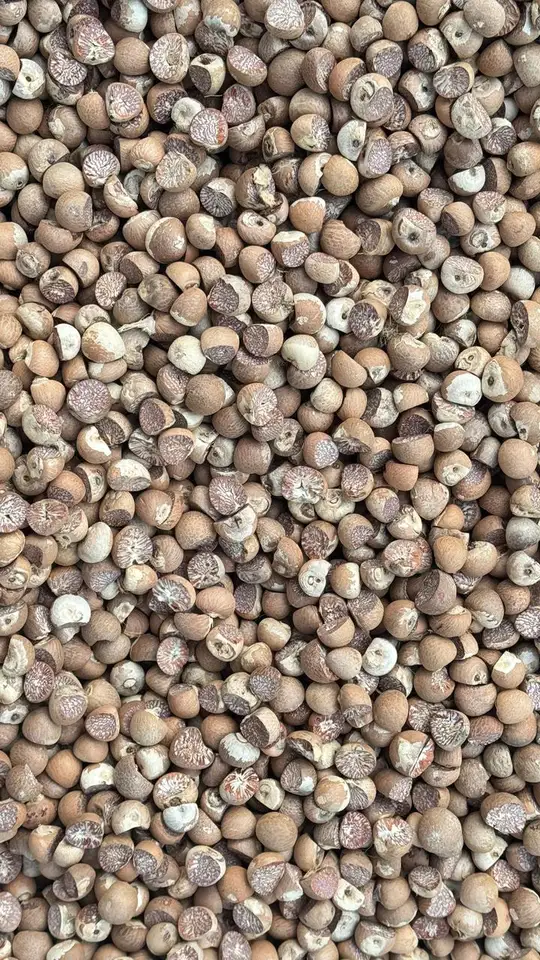
Cut areca kernels show characteristic internal patterning and variation in color and shape. In our existing photographs, the contrast between outer surfaces and cut interiors is visible. That is a description of the image, not an identification of cultivar, chemical composition or current batch quality.
A cut face can help people discuss appearance criteria and visible defects. It cannot establish the moisture of an entire delivery or replace an appropriate test. A well-lit photograph should be treated as one observation within a broader set of records.
Follow the changing weight basis
Imagine receiving fruit at one stage and selling dried kernels at another. Water removal, husk separation and rejection of unsuitable material all change the mass being measured. A difference between the two weights is not automatically unexplained loss.
An effective worksheet names the stage beside every number. It also records whether the figure is gross or net, whether packaging is included and when the weighing occurred. Without that context, even accurate scales can produce a misleading comparison.
Do not combine unlike by-products
Husk, kernel fragments and palm leaf sheaths should be described separately. Each has a different physical identity and would require a different specification in a material-use project. Calling all three betel nut waste hides information that a researcher or potential user needs.
For the same reason, a possible use for a palm sheath does not establish that broken kernels are suitable for that use. Begin with material identity, then investigate composition, contamination, processing needs and the requirements of the intended application.